Haitian Vetiver vs. Javanese Vetiver: Origins, Chemistry, and Choosing the Right One
\n\n \n\n
\n\nThe world of vetiver essential oil reveals itself through two remarkable expressions: the earthy depth of Haiti and the refined elegance of Java. These two origins have shaped the global perception of vetiver, each offering distinct characteristics that speak to different sensibilities and applications. Understanding their differences becomes a journey into terroir, tradition, and the subtle art of botanical expression.
\n\nKey Takeaways
\n- \n
- Haitian vetiver offers deeper, more complex earthy notes with higher sesquiterpene content \n
- Javanese vetiver presents cleaner, more refined woody characteristics with consistent quality \n
- Climate, soil composition, and harvesting methods significantly influence each oil's chemical profile \n
- Sustainability practices vary considerably between the two regions \n
- Price points and availability differ due to production volumes and processing methods \n
- Both origins serve distinct purposes in aromatherapy, perfumery, and mindful practices \n
Table of Contents
\n- \n
- Understanding Vetiver Origins \n
- Haitian Vetiver: The Deep Earth Expression \n
- Javanese Vetiver: The Refined Island Essence \n
- Chemical Composition Analysis \n
- Scent Profile Comparison \n
- Production Methods and Quality Factors \n
- Sustainability and Environmental Impact \n
- Choosing the Right Vetiver for Your Needs \n
Understanding Vetiver Origins
\n\nThe story of vetiver essential oil begins in the soil—quite literally. Chrysopogon zizanioides, the botanical source of vetiver, expresses itself differently across geographical boundaries, influenced by factors as subtle as seasonal rainfall patterns and as fundamental as soil mineral content. While vetiver grass grows in many tropical and subtropical regions worldwide, Haiti and Java have emerged as the two most significant commercial sources, each developing distinct characteristics that reflect their unique environmental conditions.
\n\n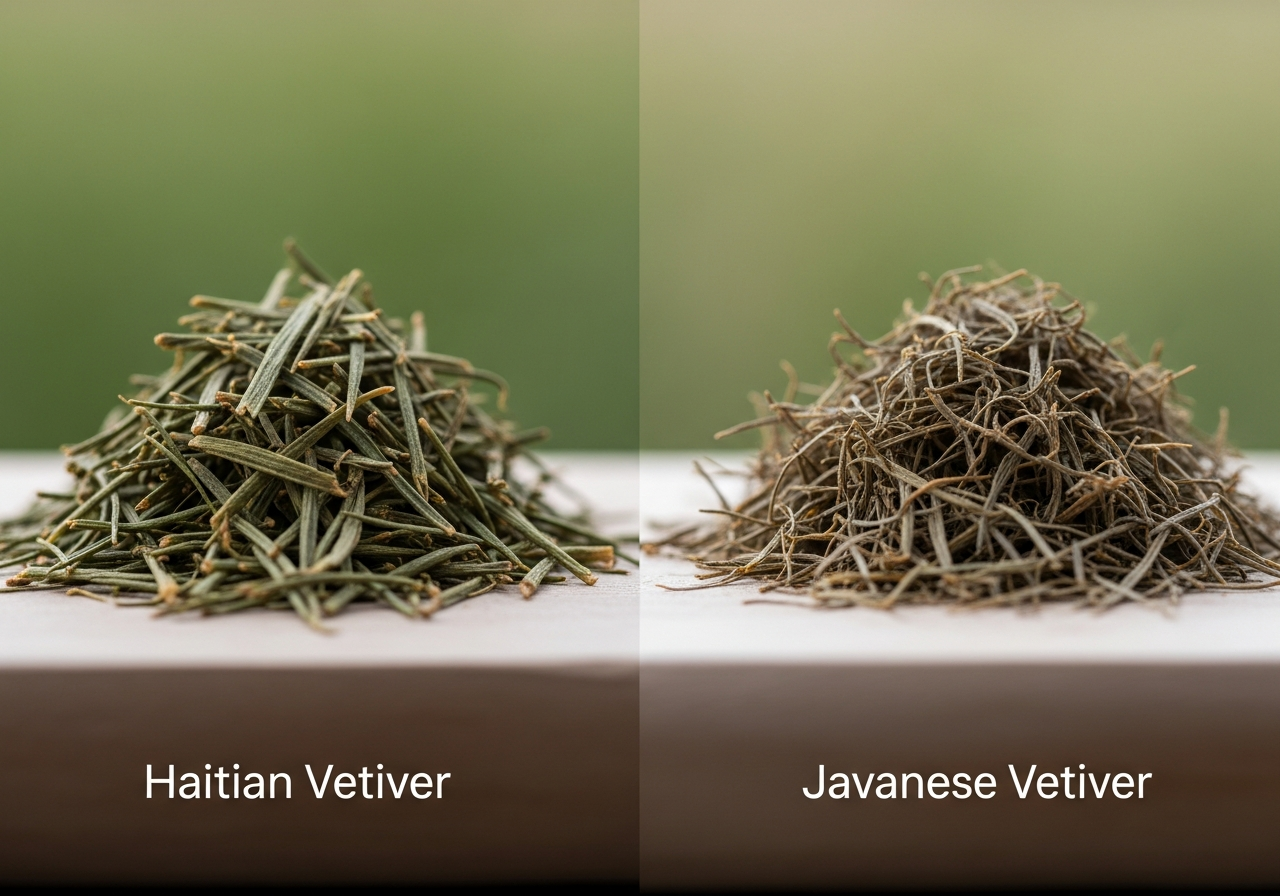 \n\n
\n\nHistorical Context and Development
\n\nHaiti's vetiver industry developed during the mid-20th century, when the island nation became a major supplier to international perfume houses. The combination of mountainous terrain, specific soil conditions, and traditional farming practices created an environment where vetiver could develop its characteristic depth and complexity.
\n\nJava's vetiver cultivation has older roots, integrated into traditional Indonesian agricultural practices for generations. The island's volcanic soil and consistent tropical climate fostered a different expression of the plant, one that perfumers and aromatherapists have come to appreciate for its refined, consistent qualities.
\n\nTerroir and Its Impact
\n\nMuch like wine grapes, vetiver roots absorb and express the characteristics of their growing environment. This concept of terroir becomes particularly evident when comparing these two origins:
\n\n- \n
- Soil Composition: Haiti's limestone-rich soils versus Java's volcanic ash create different mineral uptake patterns \n
- Climate Patterns: Haiti's varied microclimates versus Java's more consistent tropical conditions \n
- Elevation: Haitian vetiver often grows at higher altitudes, while Javanese cultivation typically occurs at lower elevations \n
- Water Sources: Different water mineral content influences root development and subsequent oil characteristics \n
Haitian Vetiver: The Deep Earth Expression
\n\nHaitian vetiver embodies the rugged beauty of its Caribbean homeland. Growing in the mountainous regions of Haiti, particularly around the southern peninsula, this vetiver develops under conditions that encourage deep root growth and complex chemical development. The result is an essential oil that many consider the gold standard for depth and authenticity in vetiver aromatics.
\n\n \n\n
\n\nGrowing Conditions and Characteristics
\n\nThe unique geography of Haiti creates ideal conditions for vetiver cultivation. The combination of steep hillsides, well-draining limestone soils, and variable rainfall patterns forces vetiver roots to grow deeper and develop more complex chemical structures. These environmental stressors, while challenging for cultivation, contribute to the oil's renowned complexity.
\n\nHaitian vetiver typically exhibits:
\n- \n
- Deeper, more penetrating earthy base notes \n
- Greater complexity in scent evolution over time \n
- Higher concentrations of certain sesquiterpenes \n
- More pronounced woody-smoky undertones \n
- Longer-lasting scent presence \n
Traditional Harvesting and Processing
\n\nThe traditional methods used in Haiti contribute significantly to the oil's character. Roots are typically harvested after 18-24 months of growth, allowing for maximum development of aromatic compounds. The extraction process often involves longer distillation times, sometimes up to 24 hours, which allows for the full extraction of heavier molecular weight compounds.
\n\nQuality Considerations
\n\nHaitian vetiver quality can vary significantly depending on the specific region, harvesting practices, and distillation methods employed. The best Haitian vetiver typically comes from:
\n- \n
- High-altitude growing regions \n
- Roots harvested at optimal maturity \n
- Traditional steam distillation methods \n
- Proper aging of the oil post-distillation \n
Understanding these quality grades becomes essential when selecting Haitian vetiver for specific applications.
\n\nJavanese Vetiver: The Refined Island Essence
\n\nJavanese vetiver presents a more refined, elegant expression of the species. Cultivated in the consistent tropical climate of Java, Indonesia, this vetiver develops under more stable conditions, resulting in an essential oil prized for its clean, woody characteristics and reliable quality.
\n\n\n\nEnvironmental Influences
\n\nJava's volcanic soil provides a different mineral profile compared to Haiti's limestone-based earth. This volcanic terroir contributes to:\p>\n
- \n
- More consistent oil composition between batches \n
- Cleaner, less complex scent profiles \n
- Higher clarity and lighter color in the essential oil \n
- More pronounced woody-cedar notes \n
- Subtle floral undertones \n
Cultivation Practices
\n\nIndonesian farmers have developed sophisticated cultivation techniques that emphasize consistency and quality. The more predictable climate allows for:
\n- \n
- Standardized harvesting schedules \n
- Consistent root development patterns \n
- More predictable oil yields \n
- Reduced variation in chemical composition \n
Processing Methods
\n\nJavanese processing often employs more modern distillation equipment and standardized procedures, contributing to the oil's consistent quality. The shorter distillation times (typically 12-18 hours) and precise temperature control result in an oil that captures the lighter, more volatile compounds while maintaining good yield.
\n\nChemical Composition Analysis
\n\nThe chemical differences between Haitian and Javanese vetiver oils reflect their environmental origins and processing methods. Understanding these compositional variations helps explain their distinct olfactory and potential applications.
\n\n\n\nMajor Chemical Components
\n\nResearch observations have identified several key differences in chemical composition between these two origins:
\n\n| Compound Category | \nHaitian Vetiver | \nJavanese Vetiver | \n
|---|---|---|
| Vetiselinenol | \nHigher concentration | \nModerate concentration | \n
| Khusimol | \nModerate levels | \nHigher concentration | \n
| α-Vetivone | \nVariable content | \nMore consistent levels | \n
| β-Vetivone | \nHigher variability | \nMore stable content | \n
Sesquiterpene Profile Differences
\n\nThe sesquiterpene composition significantly influences each oil's characteristic scent and behavior:
\n\nHaitian Vetiver Sesquiterpenes
\n- \n
- Higher overall sesquiterpene alcohol content \n
- More complex tricyclic compounds \n
- Greater presence of vetiselinenol and related compounds \n
- More variable composition between batches \n
Javanese Vetiver Sesquiterpenes
\n- \n
- More balanced sesquiterpene ketone profile \n
- Higher khusimol content \n
- More consistent bicyclic compound ratios \n
- Cleaner, less complex sesquiterpene signatures \n
Impact on Stability and Aging
\n\nThese chemical differences also influence how each oil ages and develops over time. Some research suggests that:
\n- \n
- Haitian vetiver may develop more complex notes with proper aging \n
- Javanese vetiver tends to maintain its initial character more consistently \n
- Both benefit from controlled storage conditions \n
- Chemical evolution patterns differ significantly between the two origins \n
Scent Profile Comparison
\n\nThe olfactory experience of vetiver varies dramatically between these two origins, reflecting their unique chemical compositions and environmental influences. Understanding these scent profiles helps in selecting the appropriate oil for specific applications and personal preferences.
\n\n\n\nHaitian Vetiver Scent Journey
\n\nHaitian vetiver offers a complex olfactory experience that evolves significantly from initial application to dry down:
\n\nTop Notes (First 15 minutes)
\n- \n
- Initial green, grassy freshness \n
- Slight medicinal or camphor-like quality \n
- Sometimes described as \"challenging\" on first encounter \n
- Raw, unpolished earth-like opening \n
Heart Notes (15 minutes to 2 hours)
\n- \n
- Deep, rich earth tones emerge \n
- Woody-smoky characteristics develop \n
- Complex root-like, almost mushroom-like facets \n
- Mysterious, contemplative quality \n
Base Notes (2+ hours)
\n- \n
- Warm, grounding earth presence \n
- Subtle sweet undertones \n
- Long-lasting, meditative foundation \n
- Transforms into a comforting, stable base \n
Javanese Vetiver Scent Journey
\n\nJavanese vetiver presents a more immediate appeal with less dramatic evolution:
\n\nTop Notes (First 15 minutes)
\n- \n
- Clean, woody opening \n
- Immediate accessibility and appeal \n
- Fresh cedar-like qualities \n
- Refined, polished first impression \n
Heart Notes (15 minutes to 2 hours)
\n- \n
- Smooth, creamy woody development \n
- Subtle floral undertones may emerge \n
- Balanced, harmonious middle phase \n
- Less complex but more consistent \n
Base Notes (2+ hours)
\n- \n
- Gentle, persistent woody presence \n
- Clean, uncomplicated foundation \n
- Moderate longevity \n
- Comfortable, non-intrusive dry down \n
Blending Characteristics
\n\nEach origin behaves differently when combined with other essential oils:
\n\nHaitian Vetiver in Blends
\n- \n
- Provides deep, grounding base notes \n
- Can overwhelm delicate oils if not properly diluted \n
- Excellent for adding complexity and depth \n
- Pairs well with citrus oils for contrast \n
- Complements other earth-based oils like patchouli \n
Javanese Vetiver in Blends
\n- \n
- More versatile in complex compositions \n
- Easier to balance with other ingredients \n
- Provides clean woody foundation without overpowering \n
- Excellent with floral oils \n
- Works well in fresh, modern fragrance compositions \n
Production Methods and Quality Factors
\n\nThe journey from vetiver root to essential oil involves numerous decisions that significantly impact the final product's quality, character, and commercial viability. Understanding these production differences illuminates why Haitian and Javanese vetiver oils express such distinct personalities.
\n\n\n\nHarvesting Practices
\n\nThe foundation of quality vetiver oil begins in the field with harvesting decisions:
\n\nHaitian Harvesting Methods
\n- \n
- Typically hand-harvested on steep terrain \n
- Root age varies from 18-30 months depending on conditions \n
- Seasonal timing influenced by weather patterns \n
- Traditional knowledge passed through generations \n
- Quality can vary significantly between different farmers \n
Javanese Harvesting Methods
\n- \n
- More standardized cultivation and harvesting schedules \n
- Consistent root maturity (typically 18-24 months) \n
- Better infrastructure for root handling and transport \n
- More uniform quality control from field to distillery \n
- Integration of modern agricultural practices \n
Distillation Techniques
\n\nThe extraction process plays a crucial role in determining the final oil's characteristics:
\n\nTraditional Haitian Distillation
\n- \n
- Longer distillation times (up to 24 hours) \n
- Traditional copper stills often used \n
- Steam distillation at varying pressures \n
- Less precise temperature control \n
- Results in oils with greater complexity but more variation \n
Javanese Distillation Methods
\n- \n
- More controlled distillation parameters \n
- Shorter, more efficient extraction cycles (12-18 hours) \n
- Modern equipment with precise monitoring \n
- Consistent steam pressure and temperature \n
- Higher yields with more predictable quality \n
Post-Distillation Handling
\n\nWhat happens after distillation significantly affects the final product:
\n\n| Process Stage | \nHaitian Approach | \nJavanese Approach | \n
|---|---|---|
| Filtration | \nMinimal processing, retaining sediments | \nComprehensive filtration systems | \n
| Storage | \nTraditional containers, variable conditions | \nClimate-controlled storage facilities | \n
| Quality Testing | \nLimited analytical testing | \nComprehensive chemical analysis | \n
| Aging Process | \nNatural aging in ambient conditions | \nControlled aging environments | \n
Quality Indicators
\n\nRecognizing quality in each origin requires understanding their unique characteristics:
\n\nHigh-Quality Haitian Vetiver Indicators
\n- \n
- Deep amber to brown color \n
- Complex, evolving scent profile \n
- Thick, viscous consistency \n
- Strong, lasting presence \n
- Some natural sediment acceptable \n
High-Quality Javanese Vetiver Indicators
\n- \n
- Golden to light amber color \n
- Clean, clear appearance \n
- Consistent scent profile \n
- Smooth, refined character \n
- No visible impurities or sediment \n
Sustainability and Environmental Impact
\n\nThe environmental and social sustainability of vetiver oil production varies significantly between Haiti and Java, influenced by economic conditions, agricultural practices, and environmental policies. Understanding these factors becomes increasingly important as conscious consumers seek products that align with their values.
\n\n\n\nHaitian Vetiver Sustainability
\n\nHaiti's vetiver industry faces unique challenges and opportunities related to sustainable production:
\n\nEnvironmental Challenges
\n- \n
- Deforestation and soil erosion concerns \n
- Limited access to sustainable farming education \n
- Water resource management issues \n
- Climate change impacts on traditional growing regions \n
Positive Environmental Impacts
\n- \n
- Vetiver's natural soil stabilization properties \n
- Carbon sequestration in root systems \n
- Reduced need for chemical inputs \n
- Rehabilitation of marginal lands \n
Social and Economic Factors
\n- \n
- Provides income for rural farming communities \n
- Traditional knowledge preservation \n
- Limited access to fair trade certification \n
- Economic volatility affecting farmer incomes \n
Javanese Vetiver Sustainability
\n\nIndonesian vetiver production operates within a different sustainability framework:
\n\nEnvironmental Advantages
\n- \n
- More systematic approach to sustainable agriculture \n
- Better integration with conservation programs \n
- Reduced processing waste through efficient methods \n
- Lower water consumption in production \n
Challenges and Considerations
\n- \n
- Pressure from palm oil and other cash crops \n
- Balancing modernization with traditional practices \n
- Transportation environmental impact \n
- Maintaining biodiversity in agricultural areas \n
Consumer Responsibility
\n\nChoosing between Haitian and Javanese vetiver involves considering various sustainability factors:
\n\nSupporting Haitian Production
\n- \n
- Direct economic support for vulnerable communities \n
- Preservation of traditional practices \n
- Investment in environmental restoration projects \n
- Potential for greater positive social impact \n
Choosing Javanese Sources
\n- \n
- More predictable quality and supply \n
- Often better environmental compliance \n
- Reduced risk of supporting problematic practices \n
- More transparent supply chain documentation \n
Certification and Transparency
\n\nLook for these indicators of sustainable and ethical sourcing:
\n- \n
- Fair trade certification where available \n
- Organic certification for environmental standards \n
- Direct trade relationships with transparent pricing \n
- Third-party sustainability audits \n
- Community development project support \n
Choosing the Right Vetiver for Your Needs
\n\nThe decision between Haitian and Javanese vetiver ultimately depends on your specific needs, preferences, and intended applications. This comprehensive comparison guide helps navigate the choice by considering various factors and use cases.
\n\n\n\nPersonal Preference Considerations
\n\nYour individual response to each oil's characteristics should guide your selection:
\n\nChoose Haitian Vetiver If You Prefer:
\n- \n
- Complex, evolving scent experiences \n
- Deep, grounding earth-based aromas \n
- Longer-lasting fragrance presence \n
- Authentic, traditional expressions \n
- Challenging, contemplative scents \n
- Supporting traditional communities \n
Choose Javanese Vetiver If You Prefer:
\n- \n
- Clean, accessible woody scents \n
- Consistent, predictable quality \n
- Easier blending characteristics \n
- Modern, refined expressions \n
- Immediate olfactory appeal \n
- Reliable supply and pricing \n
Application-Specific Recommendations
\n\nDifferent uses may favor one origin over another:
\n\nFor Mindfulness and Meditation
\n- \n
- Haitian Vetiver: Deeper grounding qualities, more contemplative presence \n
- Javanese Vetiver: Less distracting, easier for beginners to meditation practices \n
For Blending and Perfumery
\n- \n
- Haitian Vetiver: Adds complexity and depth to sophisticated compositions \n
- Javanese Vetiver: More versatile for various fragrance styles, easier to balance \n
For Daily Aromatherapy Use
\n- \n
- Haitian Vetiver: When seeking intensive grounding experiences \n
- Javanese Vetiver: For regular, gentle aromatherapy applications \n
Budget and Availability Factors
\n\nPractical considerations often influence the final decision:
\n\n| Factor | \nHaitian Vetiver | \nJavanese Vetiver | \n
|---|---|---|
| Price Range | \nGenerally higher, more variable | \nMore consistent pricing | \n
| Availability | \nLimited, seasonal variations | \nMore reliable supply | \n
| Quality Consistency | \nVariable between batches | \nMore predictable quality | \n
| Shelf Stability | \nMay improve with aging | \nStable from purchase | \n
Quality Assessment Guidelines
\n\nWhen purchasing either origin, evaluate these quality markers:
\n\nVisual Assessment
\n- \n
- Color appropriate for the origin \n
- Clarity level (some sediment normal in Haitian) \n
- Consistency and viscosity \n
- No signs of oxidation or contamination \n
Olfactory Evaluation
\n- \n
- Scent matches expected profile for origin \n
- No off-odors or chemical contamination \n
- Appropriate intensity and development \n
- Pleasant evolution over time on test strip \n
Source Verification
\n- \n
- Reputable supplier with transparent sourcing \n
- Batch information and testing documentation \n
- Appropriate packaging and storage \n
- Clear labeling of origin and extraction method \n
Making Your Final Decision
\n\nConsider creating a personal evaluation framework:
\n\n- \n
- Define Your Primary Use: Identify whether you're seeking vetiver for meditation, blending, daily aromatherapy, or other specific applications. \n
- Assess Your Scent Preferences: Consider whether you gravitate toward complex, challenging scents or prefer clean, accessible aromas. \n
- Evaluate Practical Factors: Account for budget constraints, availability requirements, and quality consistency needs. \n
- Consider Ethical Implications: Reflect on which sourcing approach aligns with your values regarding sustainability and community support. \n
- Test When Possible: