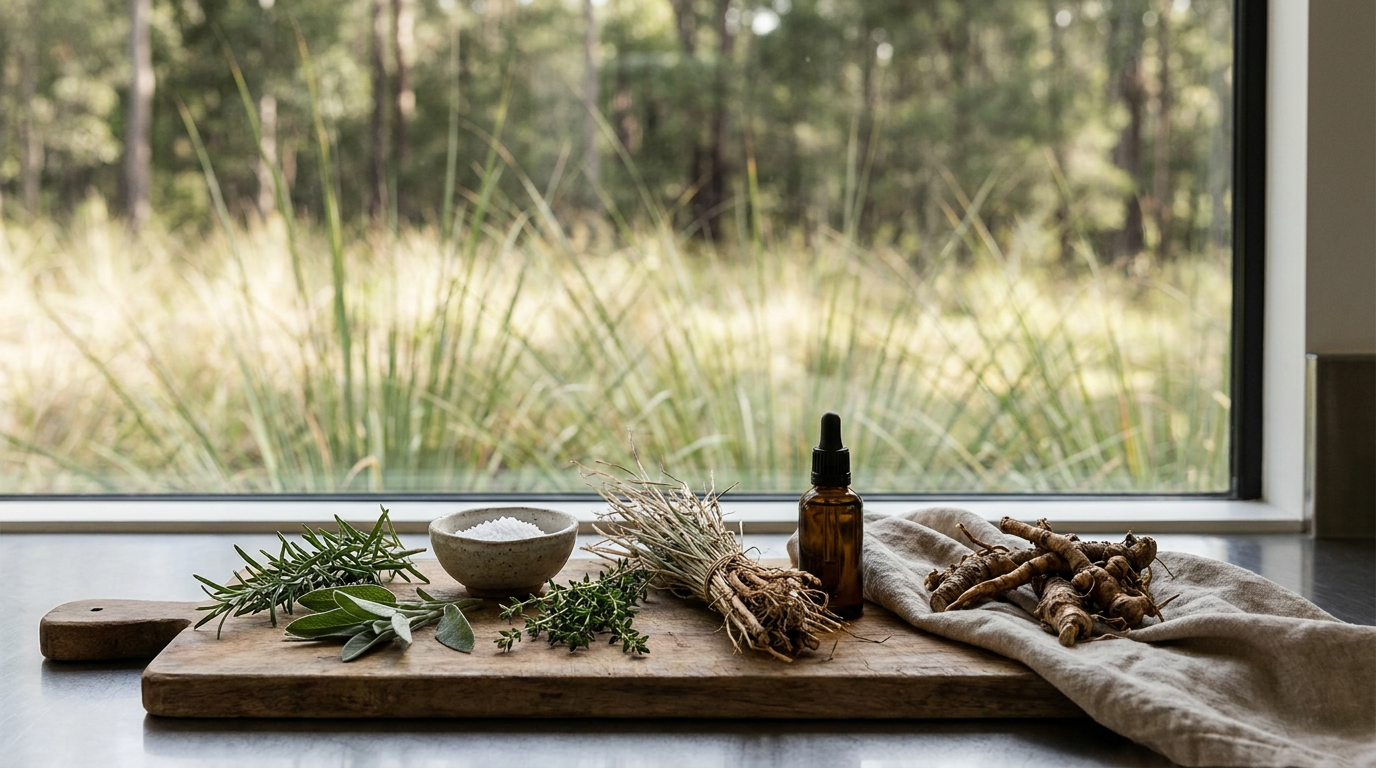
The Petrichor Blend: A Signature Vetiver Recipe for Rainy Days
There is a particular smell that rises off warm pavement in the first minute of a summer storm: mineral, green, faintly sweet, unmistakably alive. Scientists call it petrichor. Most of us just call it the smell of rain. It comes from oils that plants release into soil during dry spells and rain then lifts into the air, mixed with the metallic note of ozone and the mustiness of wet earth. You cannot bottle rain itself, but vetiver comes remarkably close. Its deep, rooty, smoky-green character is the closest a single essential oil gets to capturing that particular hush before a storm.
Vetiver Essential Oil
Our own Vetiver Essential Oil, in sizes from 0.5 oz to bulk.
From $18.99
Shop Now →This blend is built for grey afternoons, for the sound of rain on a window, for slowing down. It leans on vetiver as its backbone and rounds it out with a small supporting cast chosen to echo the different layers of a rainstorm: the green top note of freshly cut grass, the mineral lift of ozone, the damp hush of soil. Below you will find the full ingredient list in both drops and milliliters, step-by-step blending instructions, dilution guidance for different uses, and a few variations to make the blend your own.
Why Vetiver Is the Right Base for a Rain-Scent Blend
Vetiver comes from the roots of a tightly clumping grass grown mostly in India, Haiti, and Indonesia. Unlike most essential oils, which are pressed or distilled from flowers, leaves, or peel, vetiver is distilled from the root system itself, the part of the plant that spends its whole life in soil. That origin shows up in the aroma. Vetiver smells like damp earth, like a forest floor after rain, like the underside of a stone that has been sitting in a garden bed. It carries smoky, woody, and faintly sweet undertones that deepen the longer it sits on skin or in a diffuser.
That earthy, grounded quality is exactly what a petrichor-style blend needs as its foundation. Where lighter oils evaporate quickly and read as bright or citrusy, vetiver is a true base note. It anchors a blend for hours, giving the brighter, greener oils something to rest on top of. Pairing vetiver with a few carefully chosen companions lets you build something that reads less like a single flower and more like a whole weather system: soil, greenery, and the mineral snap of a passing storm.
If you want to start from a well-sourced single oil before blending, our own vetiver essential oil is a good place to begin, since blend quality depends heavily on the quality of the base note you are building from.
The Petrichor Blend: Full Ingredient List
This recipe makes roughly 10 ml of blended oil, sized for a standard 10 ml amber roller or dropper bottle used as a concentrate for diffusing. Ratios are given first as drops, since most droppers measure in drops, with milliliter equivalents alongside for anyone working from a scale or graduated pipette.
| Ingredient | Drops | Milliliters (approx.) | Role in the Blend |
|---|---|---|---|
| Vetiver essential oil | 8 drops | 0.4 ml | Base note: earthy, smoky, rooty |
| Vetiver hydrosol (optional, for a room mist version) | n/a | 90 ml | Carries the scent into a lighter mist |
| Cedarwood essential oil | 4 drops | 0.2 ml | Deepens the woody, damp-forest layer |
| Bergamot essential oil | 3 drops | 0.15 ml | Green, slightly citrus top note that mimics wet foliage |
| Clary sage essential oil | 2 drops | 0.1 ml | Herbal, slightly sweet mid note |
| Fractionated coconut oil or jojoba oil (for a roll-on version) | n/a | fill to 10 ml | Carrier oil for skin-safe dilution |
Notice that vetiver makes up close to half the total drop count. This ratio matters. Vetiver is thick, slow to evaporate, and strong enough that it can overwhelm a blend if the other oils are added in equal measure. Keeping it as the dominant note, with cedarwood as a supporting base and bergamot and clary sage as lighter accents, is what gives this blend its particular rain-after-a-dry-spell character rather than a generic woody scent.
Step-by-Step Blending Instructions
- Gather your bottle and oils. Use a clean, dry 10 ml dark glass bottle (amber or cobalt). Dark glass helps protect the oils from light degradation over the weeks you will be using the blend.
- Add the base note first. Measure 8 drops of vetiver essential oil into the bottle. Because vetiver is viscous, let each drop fall fully before tilting the bottle for the next one.
- Layer in the cedarwood. Add 4 drops of cedarwood. This should already start to smell like damp forest floor.
- Add the brighter accents. Add 3 drops of bergamot and 2 drops of clary sage. These lighter oils sit on top of the vetiver and cedarwood, giving the blend lift so it does not smell flat or one-note.
- Cap and roll gently. Secure the cap and roll the bottle between your palms for about 20 seconds. Avoid shaking hard, which can introduce air bubbles and slightly change how the blend settles.
- Let it rest. Set the blend somewhere cool and dark for at least 24 hours before first use. Essential oil blends continue to marry and settle over this period, and the aroma on day two is often noticeably more balanced than straight out of the bottle.
- Label it. Write the date and ingredient list on the bottle. This makes it easy to track shelf life and to recreate (or adjust) the recipe later.
If you are making the roll-on version rather than a diffuser concentrate, add the carrier oil (fractionated coconut or jojoba) to fill the bottle to the 10 ml line after step 5, then follow the same resting and labeling steps.
Dilution Ratios, Patch Testing, and Safety Notes
How you dilute this blend depends entirely on how you plan to use it. The concentrate above is meant for a diffuser, where a few drops go into water rather than onto skin. For any version that will touch skin, proper dilution matters.
- Diffuser use: Add 4 to 6 drops of the finished blend to your diffuser's water reservoir, following your specific diffuser's capacity guidelines.
- Room mist: Combine 10 to 15 drops of the finished blend with 4 ounces of witch hazel or high-proof vodka in a spray bottle, then top with distilled water. Shake before each use, since essential oils and water separate.
- Roll-on / skin application: A general adult dilution guideline is 2 to 3 percent, which works out to roughly 12 to 18 drops of essential oil per ounce (30 ml) of carrier oil. The recipe above, built into a 10 ml roller with carrier oil added, lands within that range.
- Patch test first. Before applying any new blend more broadly, apply a small diluted amount to the inside of your forearm and wait 24 to 48 hours, checking for any redness, itching, or irritation before wider use.
- Keep undiluted oils away from broken or sensitive skin, eyes, and mucous membranes.
- Store out of reach of children and pets. Essential oils are concentrated plant extracts and should be handled with the same care as any concentrated botanical product.
- Pregnant or nursing individuals, and anyone managing an ongoing health situation, should check with a qualified healthcare provider before introducing a new essential oil blend into a routine, since individual sensitivities vary widely.
- Citrus oils like bergamot can increase photosensitivity. If you use the roll-on version on skin that will be exposed to direct sun, consider swapping bergamot for a non-photosensitizing alternative such as petitgrain, or plan to keep the treated area covered.
Storage and Shelf Life
Vetiver itself is one of the longest-lasting essential oils on the shelf, often improving in depth over the first year or two, similar to a good patchouli or sandalwood. The blended product, however, follows the shelf life of its shortest-lived ingredient, in this case bergamot, a citrus oil that oxidizes faster than woody or rooty oils.
Store the finished blend in its dark glass bottle, tightly capped, away from direct sunlight and heat sources such as windowsills or bathroom shelves with hot showers. Under those conditions, expect the diffuser concentrate to hold its character well for 12 to 18 months. The roll-on version, once diluted with a carrier oil, has a shorter window, generally 6 to 12 months, since carrier oils oxidize over time too. If the blend starts to smell flat, sharp, or noticeably different from when you made it, it is time to mix a fresh batch.
Variations on the Petrichor Blend
1. Deep Storm (more intense, base-heavy)
For evenings when you want something heavier and more enveloping, increase the vetiver to 10 drops and add 2 drops of patchouli in place of the clary sage. This variation trades some of the brighter top notes for a darker, more grounded profile, closer to the smell of soil right after a hard rain rather than the first light drizzle.
2. First Drizzle (lighter, greener)
Reduce the vetiver to 6 drops and add 4 drops of petitgrain in place of the bergamot. Petitgrain brings a green, slightly bitter-orange-leaf note that leans closer to wet leaves than wet earth, good for daytime diffusing when you want something present but not heavy.
3. Thunderhead (smokier, more dramatic)
Swap the clary sage for 2 drops of black pepper essential oil and add 1 drop of frankincense. The black pepper brings a faint warmth and spark that echoes the electric quality of an approaching storm, while a touch of frankincense adds resinous depth without pulling focus from the vetiver base.
Whichever version you build, the core ratio principle stays the same: let vetiver anchor the blend, use one or two supporting base or mid notes to add depth, and reserve just a drop or two of a brighter oil to keep the whole thing from smelling flat. Small adjustments to that ratio are really what separate the three variations above, and it is worth experimenting in small batches (a 2 ml sample vial rather than a full 10 ml bottle) before committing a larger amount of oil to any one direction.
A Final Note on Ritual
Blends like this one work best as part of a small, repeatable ritual rather than a one-time experiment. Some people diffuse the Petrichor Blend on grey mornings with a cup of tea nearby. Others save it for the specific stretch of an actual rainstorm, letting the scent in the room match the scent outside the window. There is no fixed rule for when to use it. The point of building your own blend, measured out by hand and left to rest before its first use, is that it becomes something personal: a small, repeatable way of marking a mood, a season, or simply a quiet afternoon indoors.