How Vetiver Oil Is Made: From Root to Bottle
Vetiver oil takes more patience than almost any oil we know. A grass is grown, its roots are dug, cleaned, steamed for hours and then left to settle, and most of what separates one bottle from another is decided before the still is lit or after it is switched off. Here is the journey in order, with what the published sources can tell us about each stage.
Vetiver Essential Oil
Our own Vetiver Essential Oil, in sizes from 0.5 oz to bulk.
From $20.99
Shop Now →Digging: the plant is the harvest
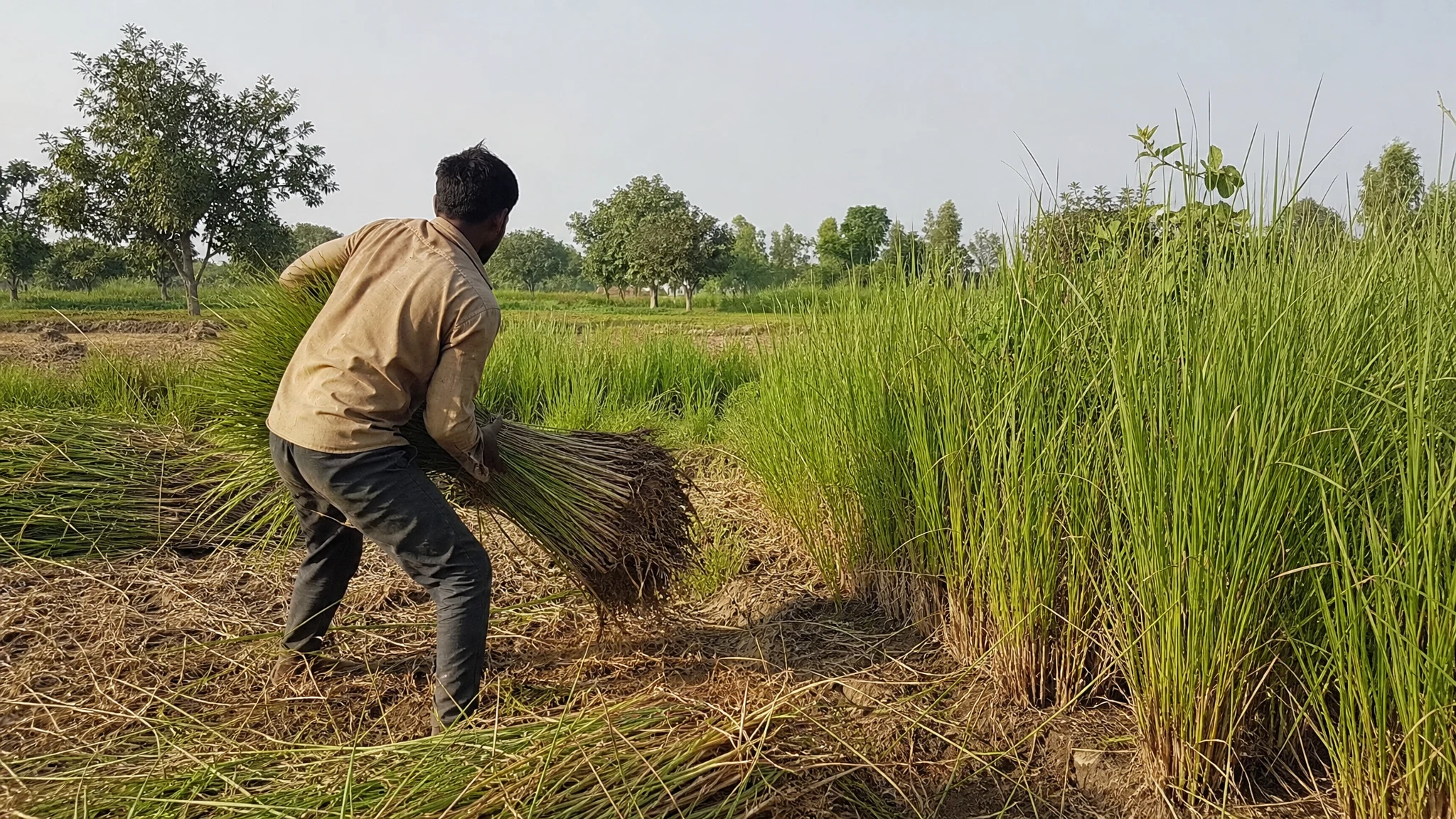
Because the oil is in the roots, collecting it means digging up the plant. Ouyang and colleagues, writing in 2021 about Haitian vetiver, estimate worldwide consumption at 300 to 400 tonnes a year, with about 60% coming from the Les Cayes commune of Haiti. We cannot check that figure ourselves, and trade numbers vary by year and by what is counted, so we treat any single production figure as an estimate. What matters for a buyer is that the Haitian harvest shapes much of the world's supply. For the ground-level side, including erosion, see our post on vetiver and soil loss, and for why the oil lives in the root at all, see the root anatomy post.

Waiting: the gap before the still
A 2024 study from CSIR-CIMAP in Bengaluru found that roots distilled seven days after harvest gave the highest oil yield, that recovery fell sharply as storage lengthened, and that tissue layers loosened and separated after about 60 days. The authors recommend distilling within 30 days (Kumara et al., 2024). It is one crop and the abstract gives no storage conditions, so read it as a direction. It does make "how long do the roots wait?" a question worth asking any seller.
The still: slow, because the molecules are big
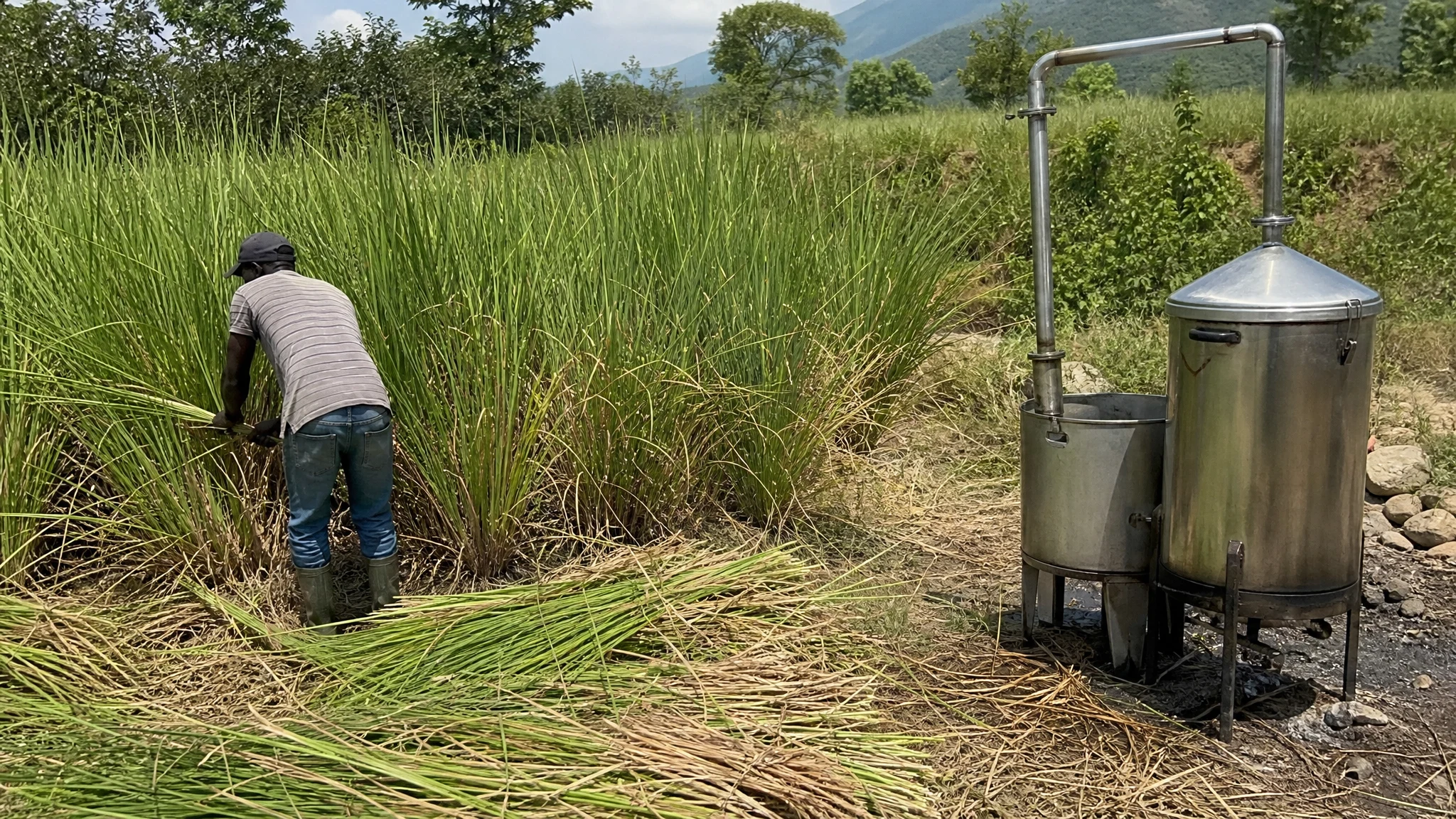
We sell a vetiver oil that is steam-distilled from roots. The same 2021 paper describes the oil as "several hundred sesquiterpene derivatives," large molecules that come over with steam slowly. Reasoning from that, a long run in the still makes sense, which we offer as an explanation rather than a measured finding. Trade pages quote anywhere from a few hours to several days, but they do not trace back to measurements, so we leave them out.
How little oil comes out
Ouyang gives a yield of about 0.2% to 0.3% from hydrodistillation of dried roots. In an Italian planting sampled across a year, yield peaked at 0.70 g per 100 g of root at eight months and fell back to 0.30 by month twelve (Massardo et al., 2003). Our arithmetic from the literature range: a kilogram of oil needs about 330 to 500 kg of dried root. At the density on our Certificate of Analysis, 0.993 g/ml, a 1 oz bottle holds roughly 29 g of oil, which at those yields is something like 10 to 15 kg of dried root. That is a calculation from a published range, not a statement about any particular production run.
Resting: vetiver changes with time
A 2011 study followed one South Indian vetiver oil for 6 to 30 months of storage. Viscosity, specific gravity and refractive index rose, while transparency, optical rotation and acid value fell. The smell moved from green, harsh and earthy toward something drier, cooler, softer, balsamic and more persistent (Dubey et al., 2011). That is one oil and one set of storage conditions, but it supports what many people notice, that vetiver rounds off with age. Our storage post turns it into practical advice.
Checking what came out
The international standard for vetiver oil, ISO 4716:2013, covers oil from seven origins including Haiti and Indonesia. It describes the oil as a viscous yellowish-brown to reddish-brown liquid with a woody, earthy odour, and sets origin-specific limits for relative density, refractive index, optical rotation, miscibility in 80% ethanol and acid value, along with a gas chromatography profile of marker compounds such as khusimol and the vetivones. The catalogue page does not show the numeric limits.
The Certificate of Analysis we publish for one batch gives a relative density at 20 C of 0.993 (standard 0.985 to 1.020) and a refractive index at 20 C of 1.525 (standard 1.520 to 1.528), and lists the extraction as steam distilled. If you need results such as GC/MS, optical rotation or acid value for a lot, ask us in writing through the contact page, and get the report in writing before you rely on it. Our post on judging a bottle explains what to look for in one.
Why it matters at the pouring stage
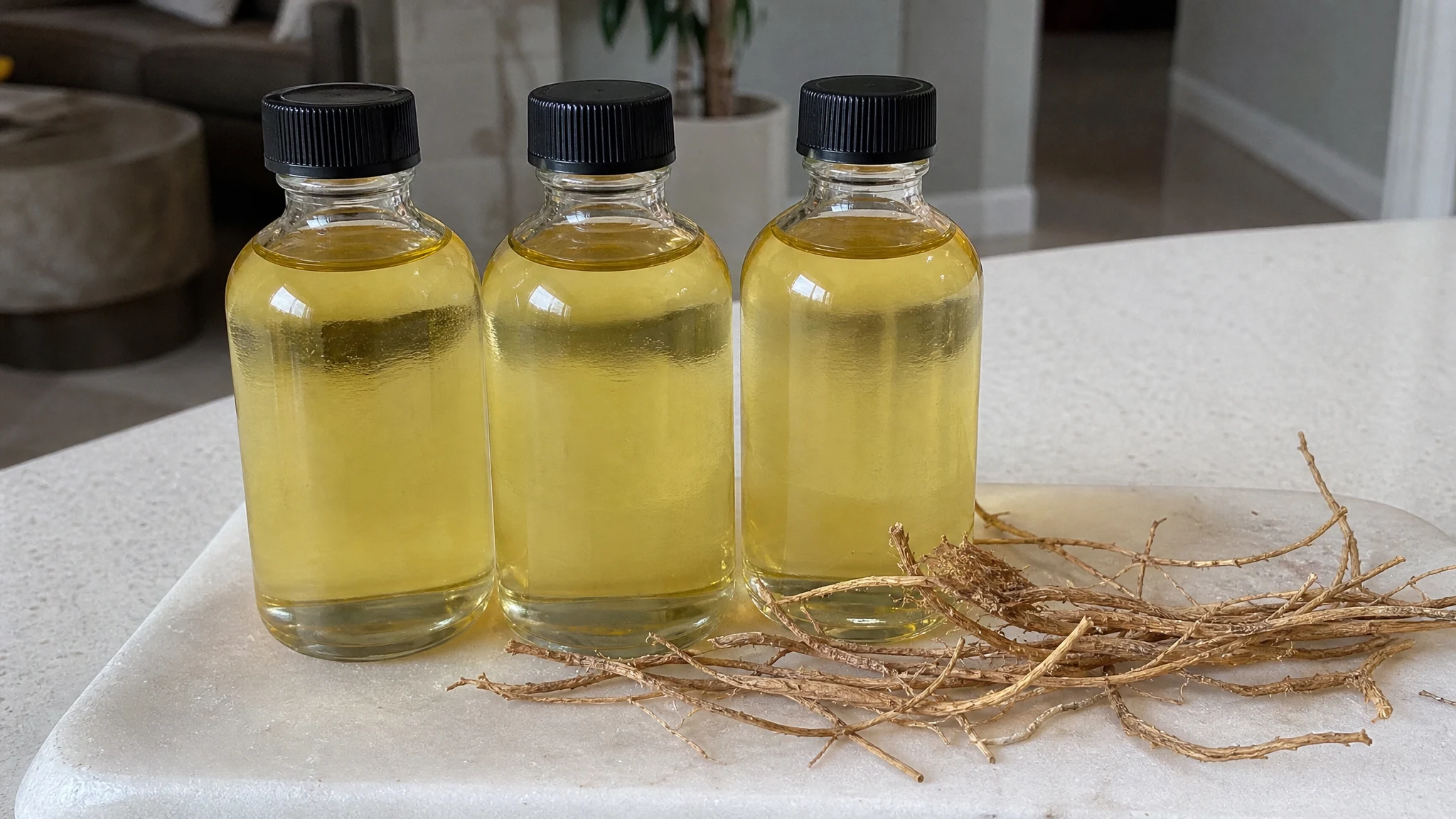
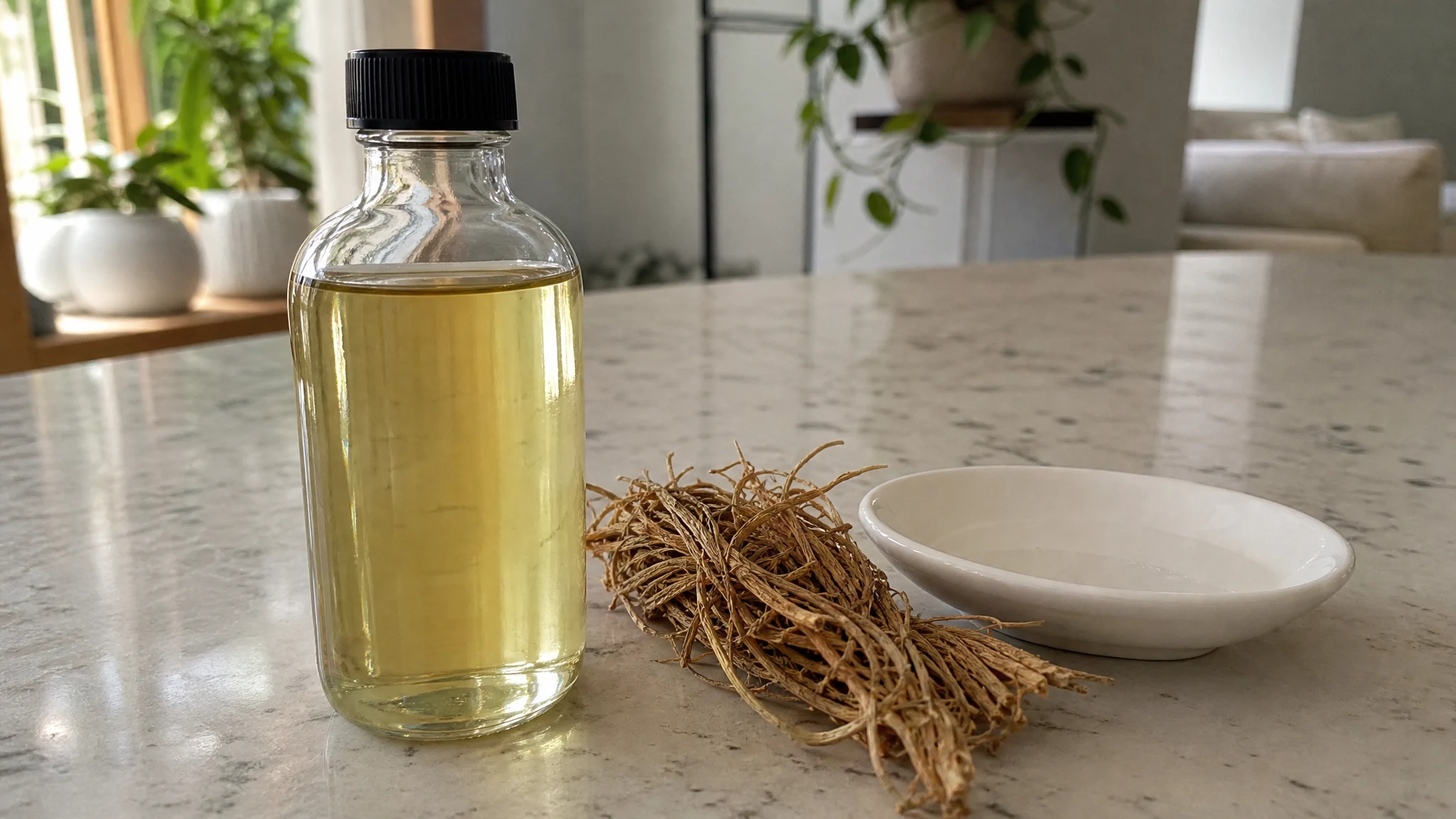
Everything in this journey shows up in the bottle in small ways. A thick oil pours slowly because it is heavy with large molecules. A dark oil looks that way because of what comes out of the root. And a smell that starts rough and rounds off with time reflects what happens as the oil rests. When you open a bottle and watch the oil slide out, you are seeing the end of a long process.
Handling it at home
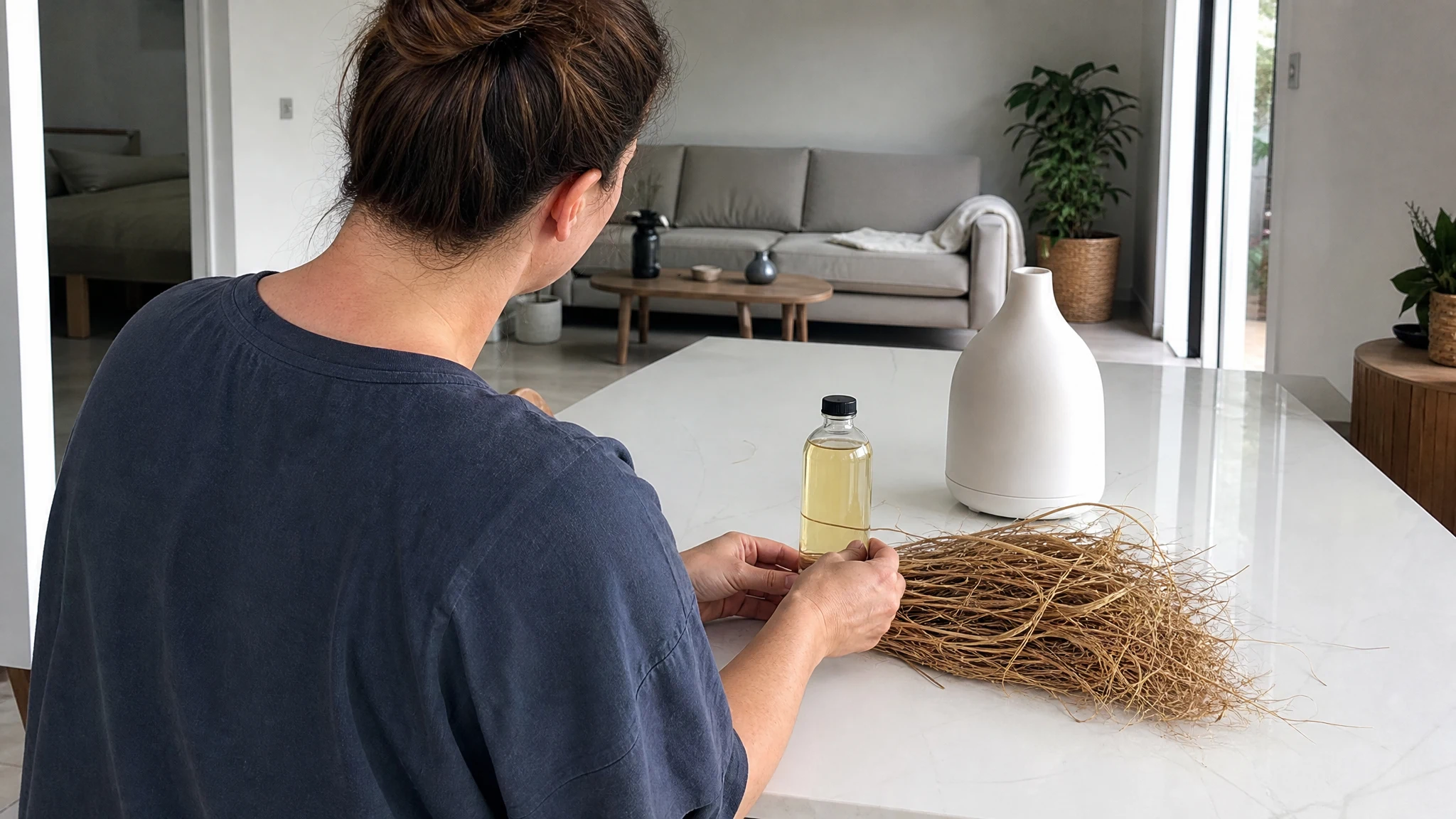
Warm the bottle in your hands for a minute before you measure it, use a pipette if you have one, and wipe the neck before capping. A little goes a very long way, so measure with care. A tightly capped bottle in a cool, dark cupboard is the best place for it between uses.
A short checklist for any seller
- How long did the roots wait between digging and distilling?
- Is there a report showing more than density and refractive index, such as a chromatographic profile for your lot?
- Can the seller say what the oil's resting time was, and what was measured before and after?
Other methods exist, and the comparison is in our steam versus CO2 post. Differences between Haitian, Javanese and Indian oils are in the origin comparison.
Digging, waiting, hours of steam and months of rest: it is a slow craft, and it is easy to see why a little vetiver goes such a long way.
Vetiver Essential Oil
Vetiver Essential Oil from our own shop, in sizes from 0.5 oz to bulk.
From $20.99
Shop Now →Sources & Further Reading
- Ouyang J et al., 2021. The Smelling Principle of Vetiver Oil, Unveiled by Chemical Synthesis. Angewandte Chemie International Edition. PMC7986879
- Kumara RR, Prakash TA, Yogendra ND, 2024. Discrepancy in essential oil yield and root structure of vetiver across different storage periods. Journal of Spices and Aromatic Crops. updatepublishing.com
- Massardo DR et al., 2003. Analysis of Essential Oil Production in Vetiveria zizanioides (L.) Nash During Early Growth (SIGA congress poster). geneticagraria.it
- Dubey N et al., 2011. Effect of Period of Storage on Physico-chemical Properties and Major Constituents of South Indian Vetiver (Vetiveria zizanioides Linn.) Oil. Indian Forester. indianforester.co.in
- ISO 4716:2013 - Vetiver Essential Oil Quality and Testing Standard (catalogue entry). standards.iteh.ai