Making a Simple Vetiver Perfume at Home: Formula and Tips
A home vetiver perfume is a lovely weekend project. It will not copy a house fragrance, which is built from dozens of materials by people who train for years, but a simple scent with vetiver as its anchor can be earthy, dry and entirely your own. Here is how to set it up: strength, a worked formula, the alcohol and what to expect after a few weeks.
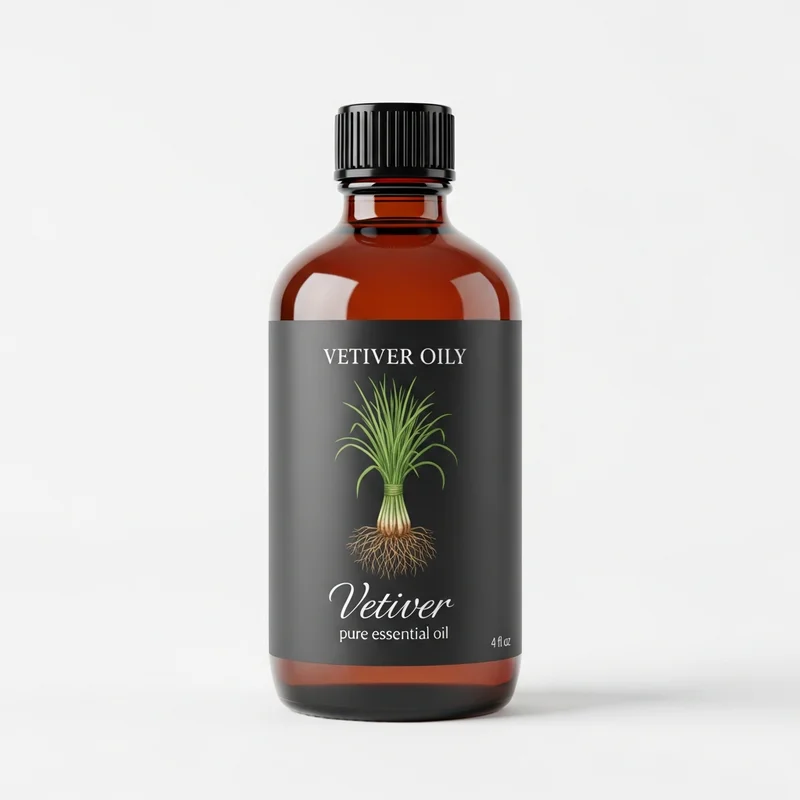
Vetiver Essential Oil
Our own Vetiver Essential Oil, in sizes from 0.5 oz to bulk.
From $20.99
Shop Now →Choose a strength and where it goes
Perfume names describe concentration, and there is no legal standard for them. One perfume retailer's guide gives averages of about 2% to 5% fragrance oil for cologne, 6% to 12% for eau de toilette, 10% to 20% for eau de parfum, and notes that these are averages. The liquid is usually ethanol, which makes it sprayable and carries the scent as it evaporates.
Skin guidance sets a different yardstick. Our dilution guidance for vetiver is 0.5% to 2% in a carrier oil with a patch test first. The Tisserand Institute gives 1% to 3% for body oils and lotions, 0.5% to 1.2% for facial products and 0.2% to 1% for sensitive skin, and calls these useful guidelines. Its chart does not cover perfume, and an eau de parfum at 15% total oil is well above every row. So the first decision is whether to make a cologne-strength product close to those figures or a stronger one you accept is beyond them.
For a first batch we suggest the cologne band, vetiver at or below 2% of the finished liquid, and applying it to clothing or one patch-tested spot rather than broad areas of skin.
A worked formula, by weight
This is a skeleton built from arithmetic, a place to start rather than a finished fragrance. Use a scale reading to 0.1 g, since drops of thick oil are large and inconsistent.
| Ingredient | Grams in 50 g | Share | Role |
|---|---|---|---|
| Vetiver essential oil | 0.8 g | 1.6% | Base note, the anchor |
| A lighter top or heart oil of your choice | 0.8 g | 1.6% | What you smell first |
| A second base (wood, resin or musk) | 0.4 g | 0.8% | Fills the middle |
| High-proof perfumer's ethanol | 48.0 g | 96% | Carrier and sprayer |
That is 2.0 g of fragrance in 50 g, or 4% in total, inside the cologne range. For the batch on our Certificate of Analysis (relative density 0.993 at 20 C) 0.8 g of vetiver is about 0.8 ml. We describe our oil as thick and slow-pouring, so weigh it straight into the vessel on the scale and skip counting drops.
Two cautions on the other ingredients. If you pick citrus for the top, the type matters, because the phototoxic citrus oils are the expressed rind oils, not distilled ones. And whatever partner oils you choose, patch test the whole blend, not only the vetiver in it. A large German analysis of patch-test data from 2010 to 2019 found that several essential oils, sandalwood among them, provoked reactions in dermatology patients.
Why vetiver sits at the base
Vetiver has a real place in perfumery. The 2021 study that unveiled its key odorant calls it one of the finest and most popular perfumery materials, present in over a third of all fragrances. It breaks the scent into parts: grapefruit-like from the vetivones and nootkatone, earthy from geosmin and creamy, sandalwood-like from a third molecule. That is why your bottle may smell different at the neck than it does an hour after it hits the skin. Perfumers also call vetiver a fixative, meaning it slows the evaporation of lighter notes, and we like it for that role. Judge the effect with your nose and a scent strip rather than a promise.
Order of work
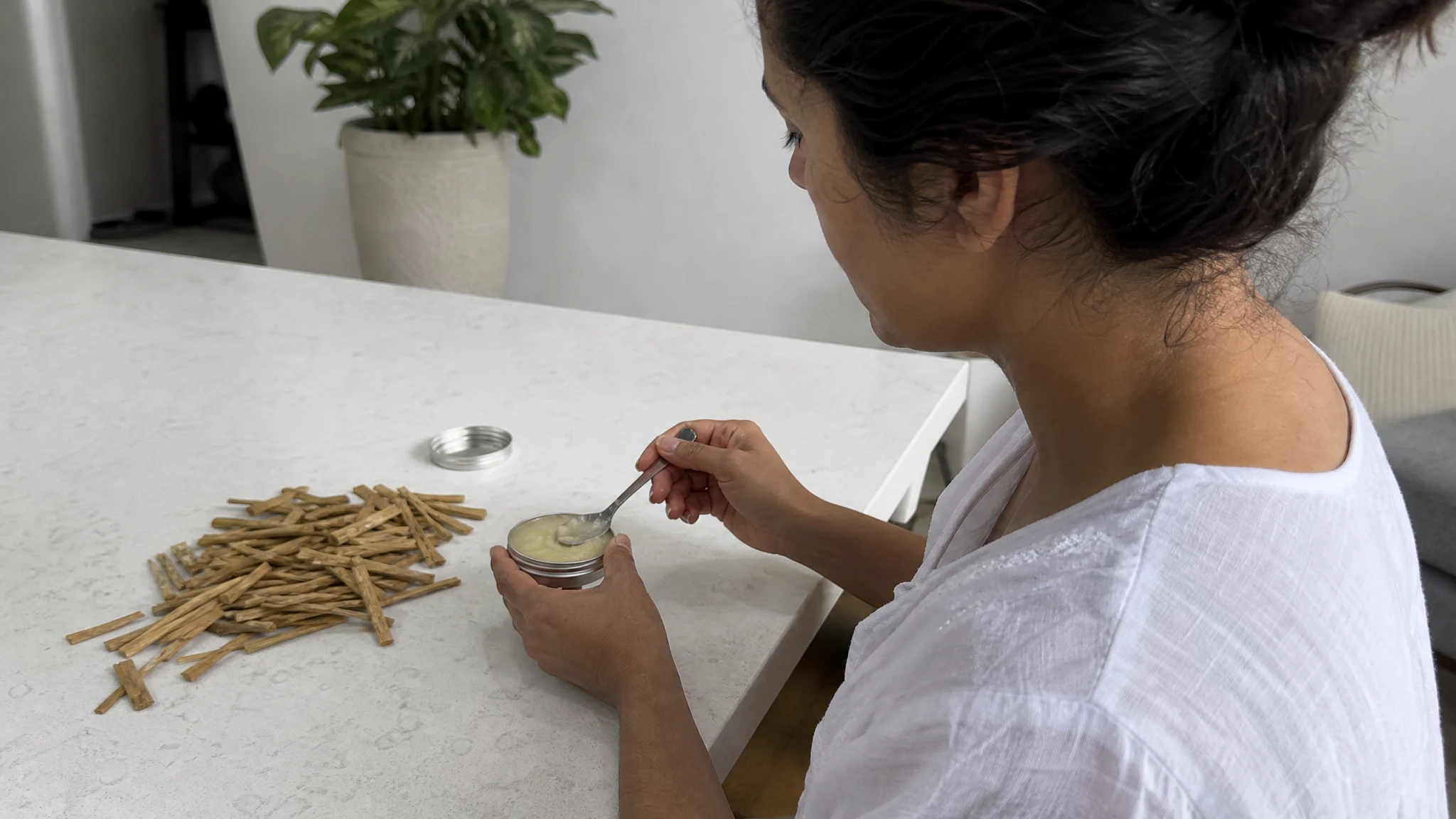
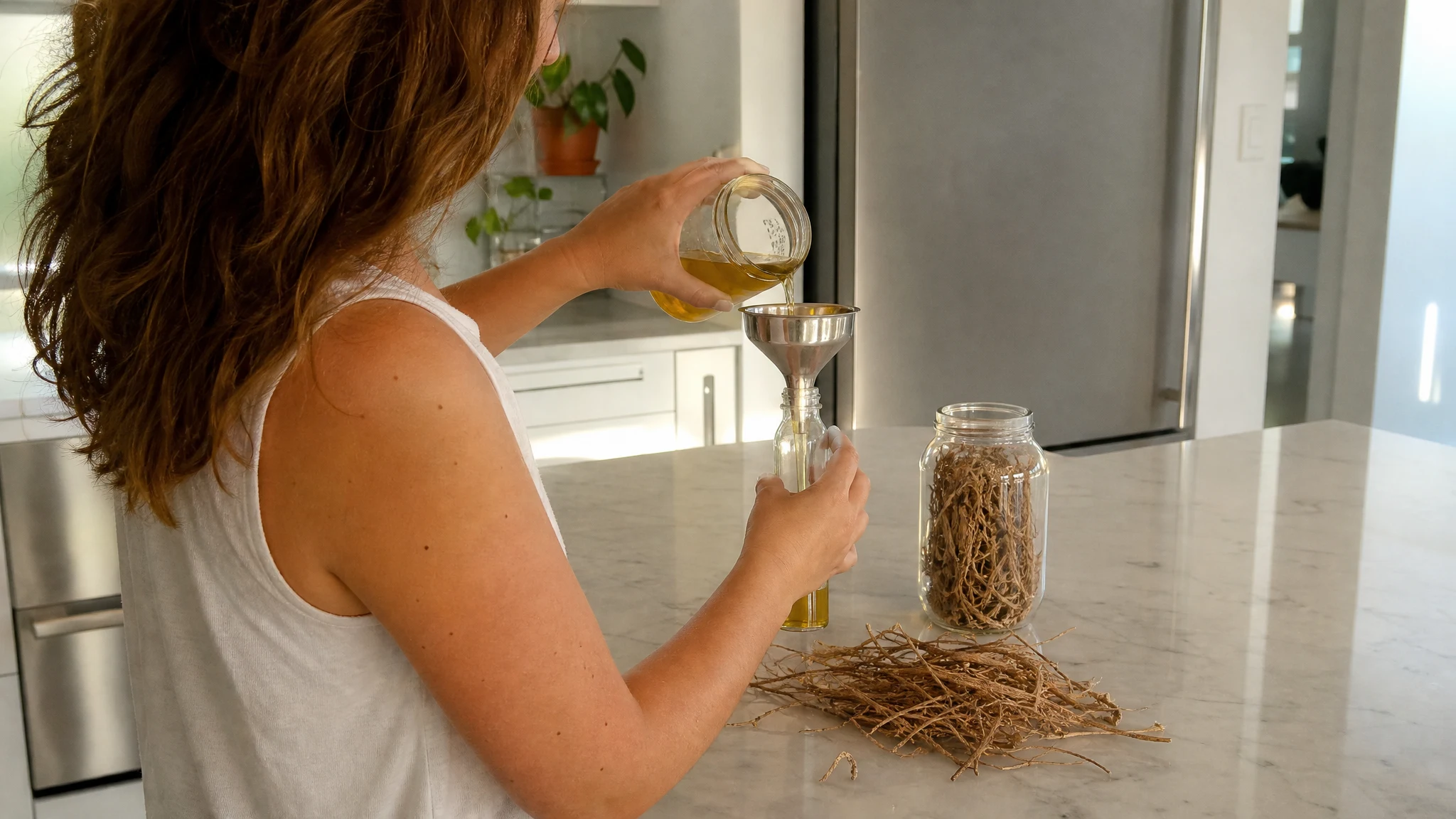
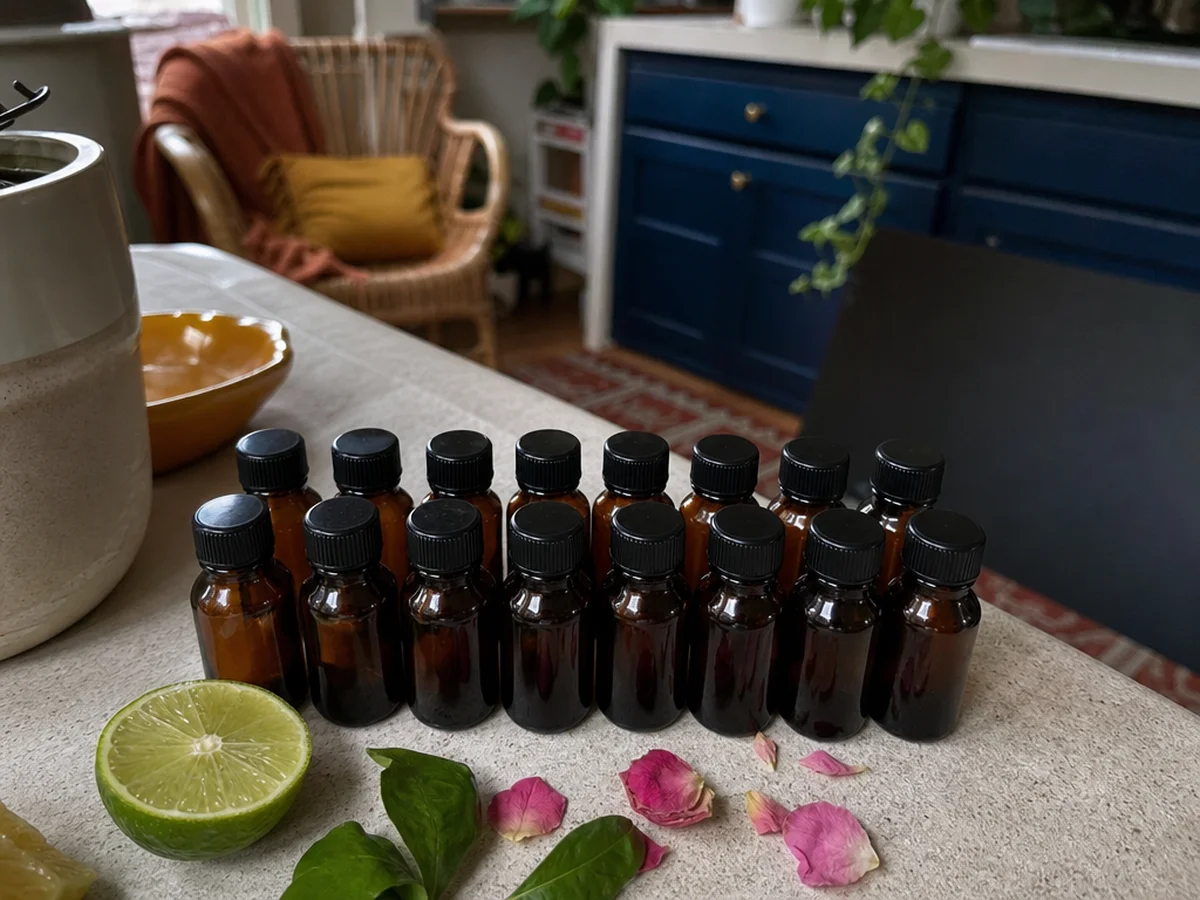
- Weigh the vetiver and second base into a small glass vessel first, then the lighter oils.
- Add the ethanol and stir. Hold the liquid against a white card. Cloudiness or sediment means something has not dissolved.
- Rest it in a closed, dark bottle for a few weeks. Test on a scent strip after one week and again later, and write down what you smell.
- If sediment forms, pass the liquid through a coffee filter. A 2011 storage study of South Indian vetiver oil measured falling solubility in 80% alcohol as the oil aged over 6 to 30 months, so older oil may be likelier to haze.
- Patch test on the inner forearm and wait a day before wearing it widely.
Where to go next
We sell the vetiver oil only, so the ethanol, bottles and partner oils come from a perfumery-supplies seller. If you want a men's cologne angle, see our vetiver cologne spray. For the thinking behind building layers, see how to layer vetiver, and to know what you are smelling, what vetiver smells like. If you need batch data for a formulation, ask in writing through the contact page.
Wearing and keeping it
When you first spray a fresh blend, the alcohol smell comes first and fades within a minute or two, so give it a moment before you judge it. Spray onto a scent strip or your clothing from a little distance, and notice how the scent changes over the next hour. Vetiver tends to be the part that is still there at the end of the day, which is exactly why we like it as an anchor.
Store the finished perfume in a closed, dark glass bottle, out of the sun and away from a hot bathroom shelf. Label it with the date and the weights, so you can repeat a blend you love or adjust one that is not quite right. A small notebook beside your scale is one of the best tools you can own.
Keep it simple, let it rest, and enjoy a perfume that smells like you made it.
Vetiver Essential Oil
Vetiver Essential Oil from our own shop, in sizes from 0.5 oz to bulk.
From $20.99
Shop Now →Sources & Further Reading
- Perfume concentrations explained | Perfume Lounge
- Dilution for essential oils, Tisserand Institute
- Citruses: a comparison of different oils, Tisserand Institute
- Contact sensitization to essential oils: IVDK data of the years 2010-2019. Geier et al., Contact Dermatitis, 2022
- The Smelling Principle of Vetiver Oil, Unveiled by Chemical Synthesis, Ouyang et al., Angewandte Chemie, 2021
- Effect of Period of Storage on Physico-chemical Properties and Major Constituents of South Indian Vetiver (Vetiveria zizanioides Linn.) Oil, Dubey et al., Indian Forester, 2011