Vetiver vs Myrrh Oil: Which Base Note Suits You?
Search for "myrrh oil" and "skin" together and you will find a confident-sounding study about wounds in mice and rats. Look closer and the plant is not the one most people mean by myrrh. That small mix-up is a good way into this comparison, because vetiver and myrrh are often shelved together as deep, resinous-feeling base notes, and the skin stories around both are thinner than the marketing suggests.
Vetiver Essential Oil
Our own Vetiver Essential Oil, in sizes from 0.5 oz to bulk.
From $20.99
Shop Now →The myrrh study that is about a cousin
The 2015 paper most often quoted tested ointments made from the essential oil and a resin extract of Commiphora guidottii, known as scented myrrh. The true myrrh of perfumery and incense is Commiphora myrrha. In the rodent experiments the ointments were compared with plain ointment and a reference drug, and the authors concluded the plant had wound-healing activity that supports its traditional use. That is a reasonable finding for a rodent study of a related species. It is not a trial of myrrh essential oil on human skin, and it does not tell you what a bottle labelled myrrh will do.
Naming is a real issue in this corner of the market. A chemistry paper from 2002 looked at furanosesquiterpenes in several Commiphora species and framed the related plants as adulterants of true myrrh. When you buy any resin oil, the species on the label matters.
What vetiver has been tested for on skin
The most complete look at vetiver oil in cosmetics is a laboratory screen of three commercial oils. The team ran test-tube assays for antioxidant, whitening, anti-inflammatory and antimicrobial activity, and their conclusion was refreshingly direct: vetiver oil shows no particularly significant and innovative cosmetic potential apart from its scent. We think that is the right way to hold it. Vetiver's value in a skin product is the fragrance, and what a lab bench shows is not what happens on a person.
Our oil is sold for aromatic and cosmetic use, and we make no skin-repair claims for it. If you want to read more, our piece on vetiver and skin goes through what is and is not supported.
Where the two really do overlap
The overlap is perfumery. Both oils are used as deep, slow-evaporating anchors, and formulators often call vetiver a natural fixative. We describe ours as a base note with a deep, earthy, smoky-sweet scent. Myrrh is a different material, and since we do not sell it we would encourage you to smell it for yourself. If a deep base is your goal, our guides to vetiver in perfumery and layering vetiver show how that works in practice, and our comparison with sandalwood covers another classic base note.
Two thick oils, one bit of patience
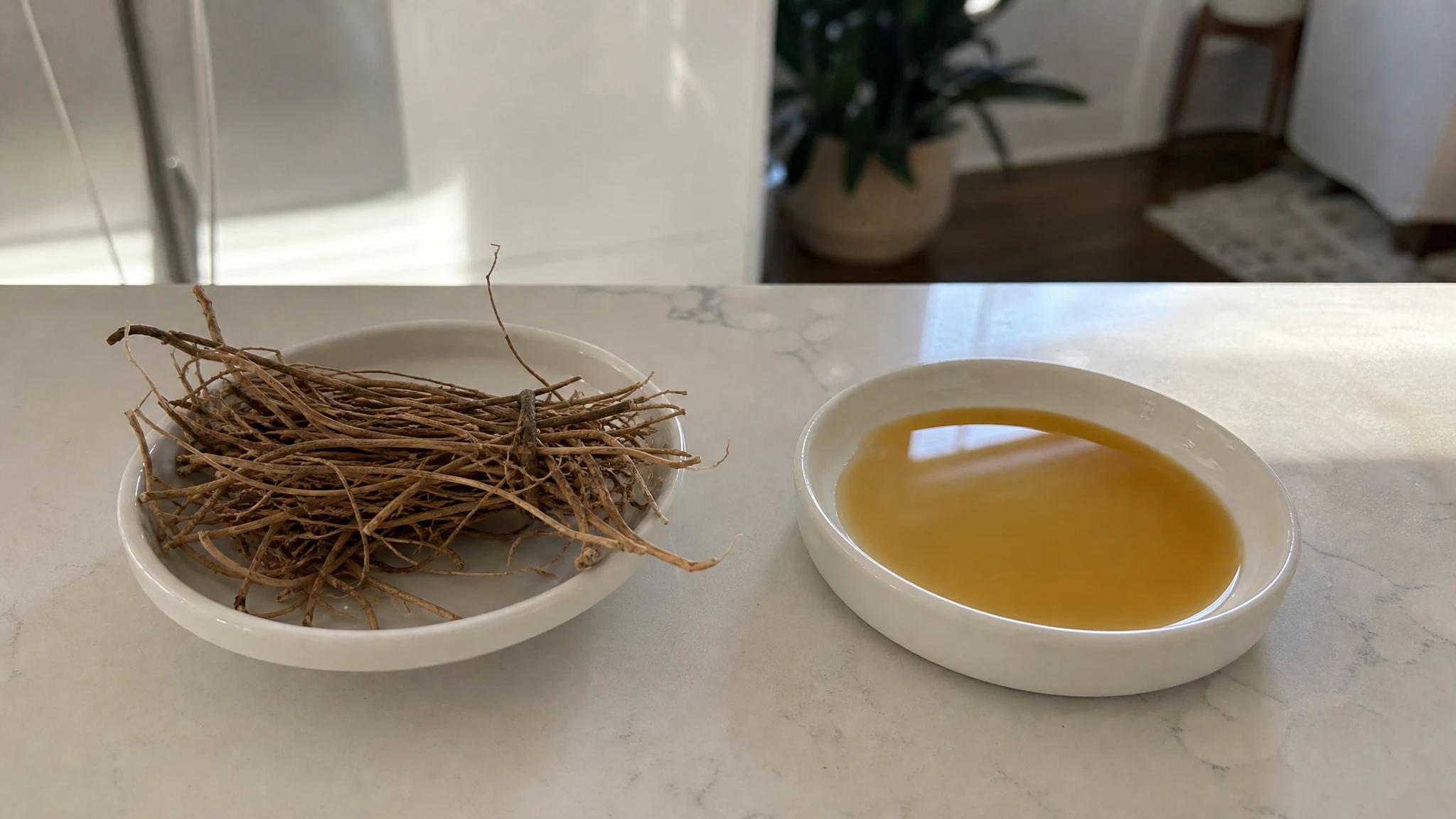
Both of these are heavy materials, and heavy materials reward slow handling. Vetiver pours slowly, particularly when cool, so warm the bottle in your hands for a few minutes and use a pipette if you want control. Wash your hands or wipe the bottle between oils if you are comparing two, because a stray trace of one will muddy the other on the strip.
Give each strip a few minutes before you form an opinion. Vetiver tends to make its case slowly, deep and smoky first and then softer, and a base note that wins on a minute-one sniff is not always the one you will still enjoy at the end of the evening.
Whichever you choose, make a small first batch of whatever you are creating. A deep base note is a long-lasting commitment in a candle or a perfume, and a small trial costs less than a big mistake.
If your actual question is a cut or a rash
Then neither oil is the answer, and we would not put an essential oil, ours or anyone's, on broken skin. Cuts, rashes and eczema belong with a doctor or dermatologist, and anything on a child with a pediatrician. We say this without drama: oils are for fragrance and for diluted use on healthy skin, and that is where they shine.
Using vetiver on healthy skin
We sell our oil neat and recommend diluting it to 0.5% to 2% in a carrier oil such as jojoba or sweet almond (we do not sell those, so look for them at a craft or supply shop). We start at 0.5%, patch test on a small area first, and keep the oil away from eyes, children and pets. Check the IFRA standards for your own formulation if you are making a product. Our safety and dilution guide has the steps.
How we would choose
Choose on scent and on the job you have in mind. Vetiver is a good fit if you like an earthy, smoky base note and want to build a perfume, a candle or a diffuser blend around it. Myrrh is worth exploring if you prefer something resinous, ideally from a seller who names the species and the plant part. Whichever you pick, ask for the batch report for the lot you are buying. A buyer who wants GC-MS data or other tests for our vetiver can ask us in writing through the contact page; the Certificate of Analysis we publish covers one batch and lists density and refractive index.
Both oils are best loved for what they smell like and the depth they give a blend, and that is plenty.
Vetiver Essential Oil
Vetiver Essential Oil from our own shop, in sizes from 0.5 oz to bulk.
From $20.99
Shop Now →Sources & Further Reading
- Gebrehiwot M et al., Evaluation of the wound healing property of Commiphora guidottii Chiov. ex. Guid. BMC Complement Altern Med, 2015
- Dekebo A, Dagne E, Sterner O, Furanosesquiterpenes from Commiphora sphaerocarpa and related adulterants of true myrrh. Fitoterapia, 2002
- Burger P et al., Vetiver Essential Oil in Cosmetics: What Is New? Medicines (Basel), 2017