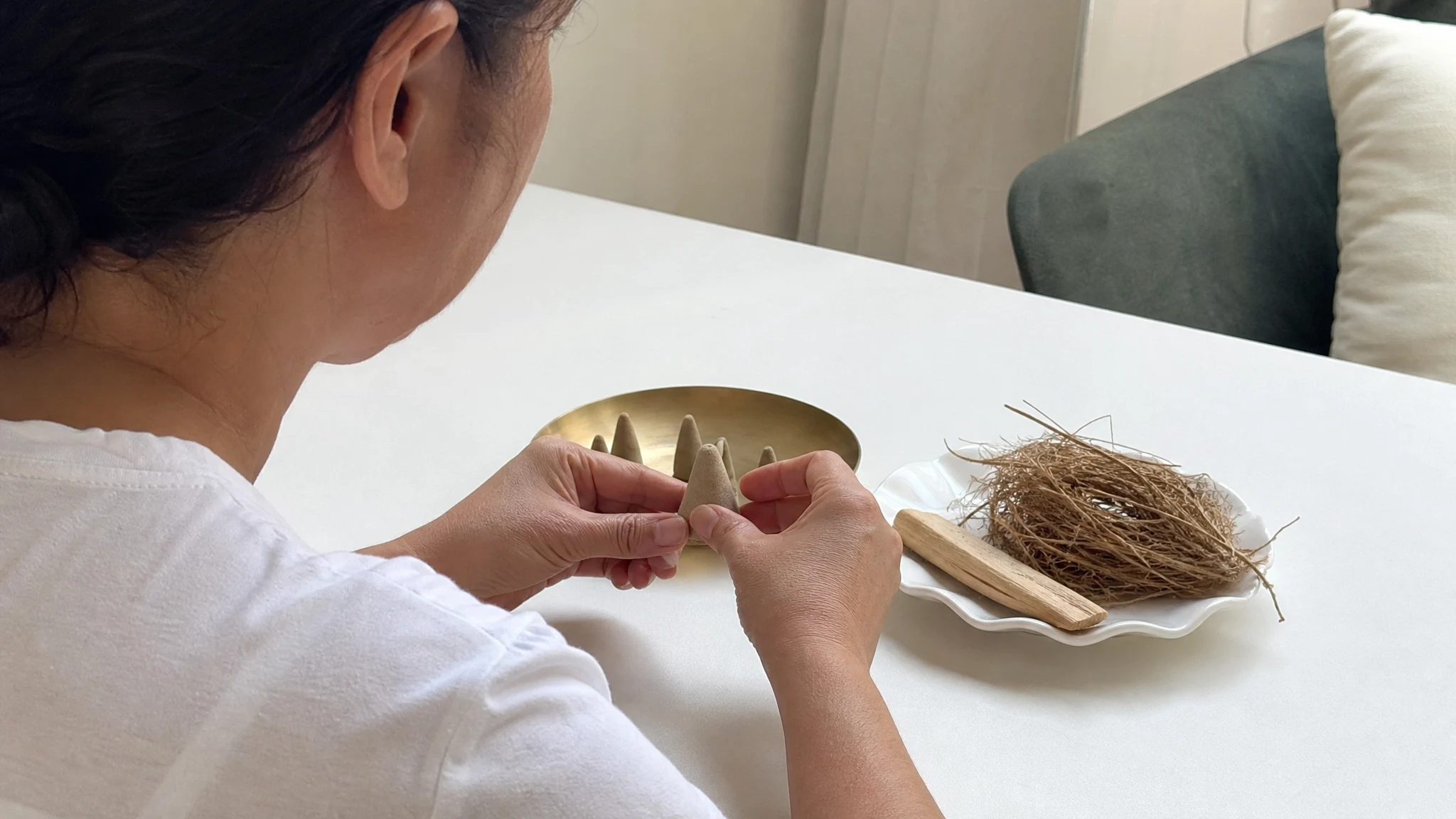
Vetiver and Sandalwood Incense Cones: DIY Recipe
Few DIY projects end in smoke, which is exactly why incense deserves a bit of thought before you start. A cone of vetiver and sandalwood can smell wonderful: dark, woody, a little sweet. You can make one at home with just a few ingredients. Burning it indoors does mean breathing smoke, though, so we will give you the formula and then the sensible way to use it.
Vetiver Essential Oil
Our own Vetiver Essential Oil, in sizes from 0.5 oz to bulk.
From $20.99
Shop Now →A cone is not the only way to enjoy the scent
If all you want is the aroma of vetiver and sandalwood during a quiet sit, a cone is the route that burns material. A few drops of oil on a ceramic scent stone, or a short diffuser session as described in our diffuser post, gives you the smell without a flame. Cones are worth making if you enjoy the making, and will burn them occasionally, one at a time, in a ventilated room. That is the use this post is written for.
What is known about incense smoke
Most of the research comes from places where incense is burned daily, so applying it to an occasional cone at home is an inference. A review in Clinical and Molecular Allergy notes that burning incense produces particulate matter at more than 45 mg per gram burned, compared with about 10 mg per gram for cigarettes, along with gases and volatile compounds, and advises reducing exposure time and ventilating the house when burning incense at home (Lin TC et al., Incense smoke: clinical, structural and molecular effects on airway disease. Clin Mol Allergy 2008). A large Singapore cohort followed 61,320 adults for years and linked long-term, heavy incense use to a higher risk of squamous cell carcinomas of the respiratory tract, with a relative risk of 1.8 among long-term users (Friborg JT et al., Incense use and respiratory tract carcinomas: a prospective cohort study. Cancer 2008).
That is long-term daily exposure, not an occasional cone. But a recent clinical article describes a woman with COPD and asthma whose breathlessness followed incense burning, and an asthmatic woman whose symptoms were triggered by candles lit for meditation, and suggests shorter burn times, better ventilation and electronic alternatives (Lam G et al., Cultural sensitivity and patient-centered care regarding incense and candle smoke emissions. Front Allergy 2026). Our reading is straightforward. If you have asthma, COPD or another lung condition, ask your physician before burning incense indoors, and if you share a home with infants or someone with airway disease, a cone is probably the wrong choice.
The formula
This is a formulation worked out from the cited makers' guidance and arithmetic. Make a small first batch.
| Ingredient | Amount |
|---|---|
| Makko (Japanese incense binder powder) | 25 g |
| Sandalwood powder | 75 g |
| Vetiver essential oil | 3 g (3% of the dry weight) |
| Warm water | a little at a time |
Makko is a bark powder that works as both binder and fuel. A Japanese incense maker says at least 10% makko should be used, with more sometimes needed depending on the other ingredients (Baieido, Making Incense By David Oller). We use 25% so the dough holds its shape in a mold; that is above the stated minimum, not a proven optimum.
For the oil, one supplier's guidance suggests starting at about 3% to 8% of the dry powder and binder weight and increasing only if the cone avoids excess smoke, oil leakage and flare-up (MySkinRecipes, Making Incense Cones and Fragrance Ratio). We start at 3% because vetiver is a heavy oil that tends to pool rather than blend. The batch on our Certificate of Analysis has a relative density of 0.993 at 20 C, so 3 g is close to 3 ml; weigh it rather than counting drops.
Method
- Mix the makko and sandalwood powder dry and evenly. Wear a dust mask, since both are fine powders.
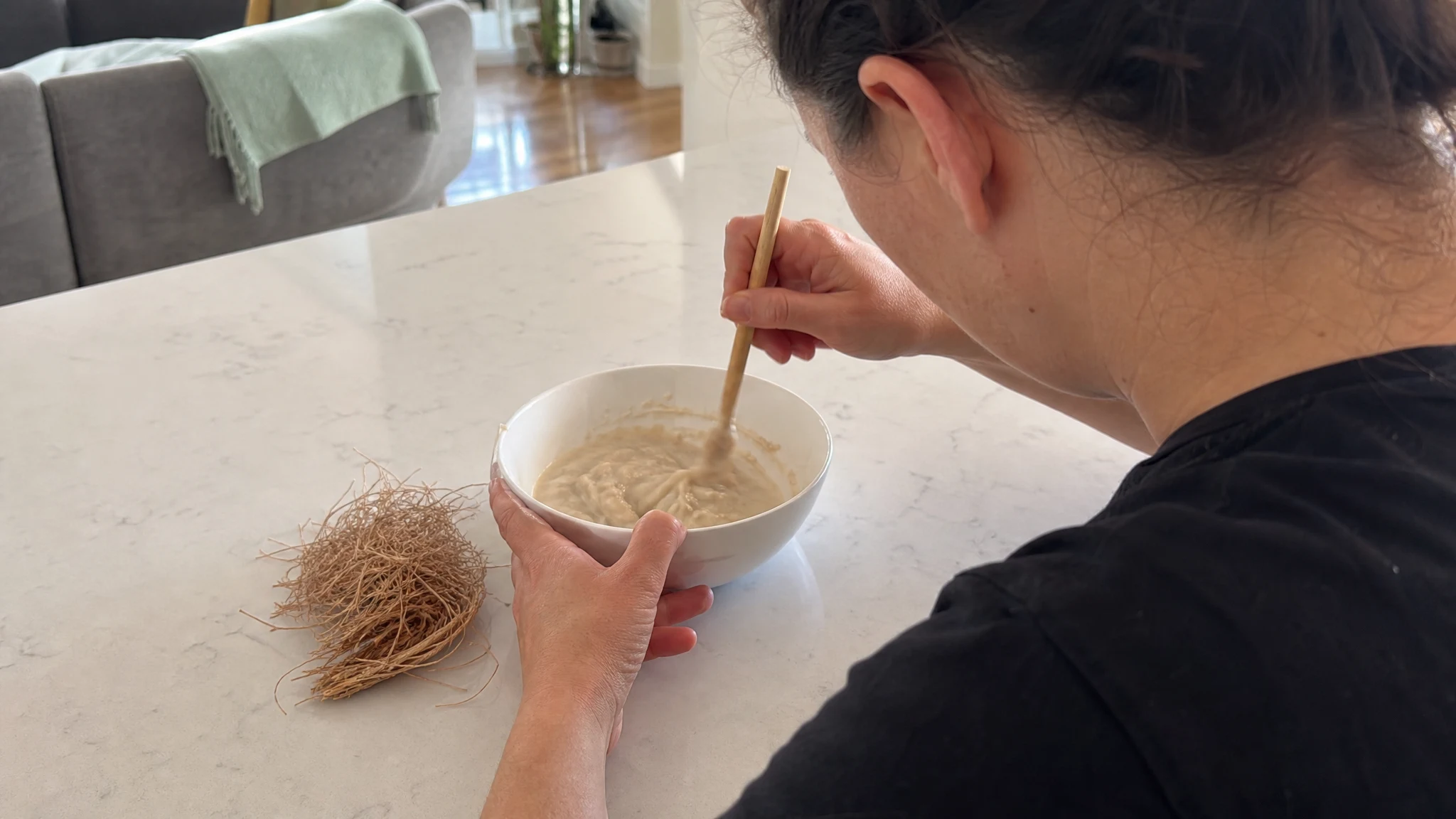
- Add warm water a little at a time while kneading until the dough is consistent. Baieido gives the same advice.
- Knead the vetiver oil into the damp dough rather than the dry powder, so it spreads evenly.
- Press into cone molds and release. Let the cones dry completely, for several days at least; the same maker's sticks take about a week in summer and ten days in winter.
- Light one test cone on a heat-resistant holder, away from anything flammable, in a ventilated room. Check that it ignites, burns to the base and does not smoke heavily or leak oil. Only then consider raising the oil share.
Troubleshooting
A cone that smolders badly or goes out usually has too much oil or too little binder. Natural ingredients do not remove smoke; wood and bark give off combustion products too. Sandalwood is also worth asking about: if a powder is sold only as "sandalwood," ask the seller for the species and origin. We sell the vetiver oil only, so makko, sandalwood and molds come from an incense-supplies seller. For another way to compare the two scents, see our vetiver and sandalwood comparison.
Working with the dough
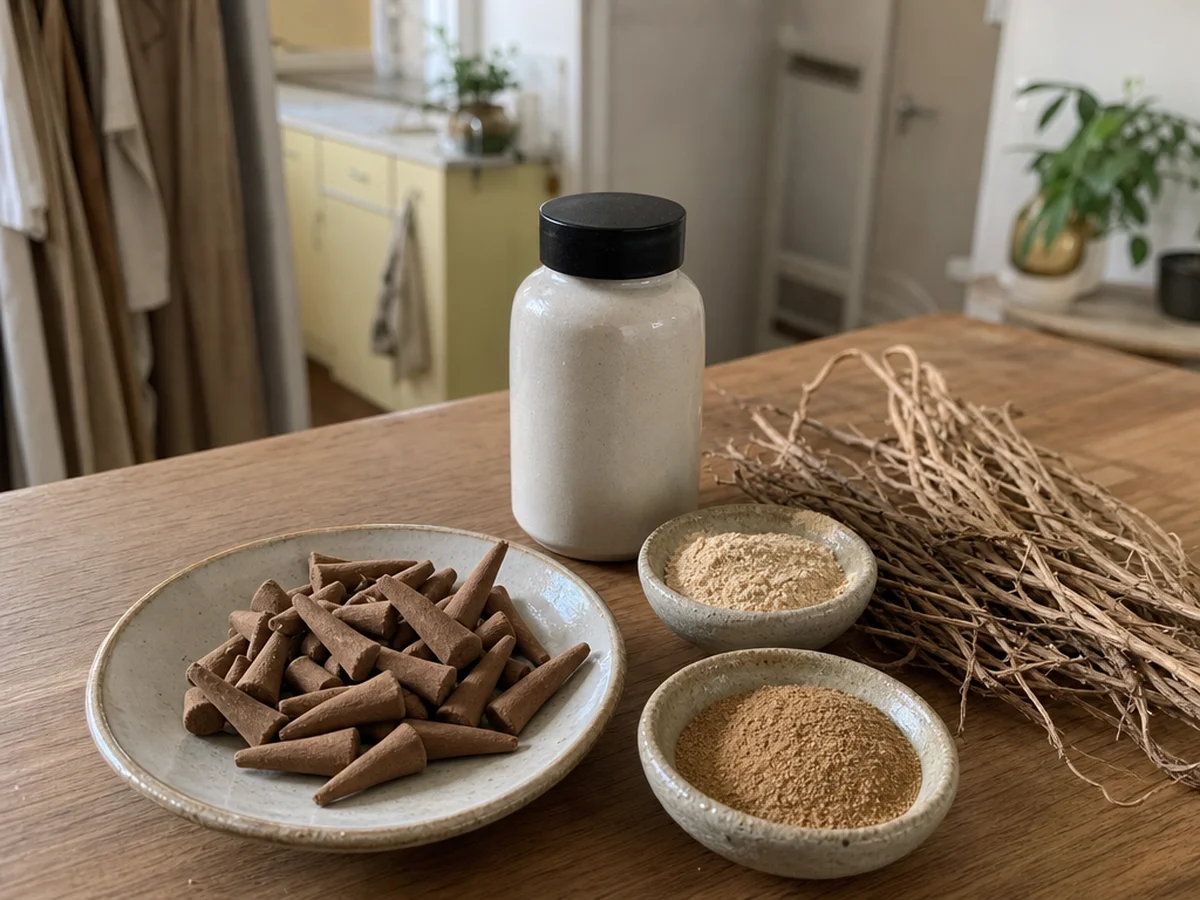
The dough is the satisfying part. It should feel like a firm modelling clay: damp enough to hold together, dry enough that it does not stick to your fingers. If it crumbles, add a few more drops of warm water. If it smears, dust in a little more of the dry mix. Because vetiver is thick and dark, you will see the oil spread through the dough as a deeper brown, and a patient knead gives an even colour all through.
Make a few cones in different sizes and keep a note of which was which. It is easy to forget, and a log of what you did lets you repeat the one that burned well.
Storing finished cones
Once dry, keep the cones in a tin or a lidded jar away from heat and damp. The smell will be quiet in the jar and fuller when lit, so do not judge them by sniffing the tin alone. Label the batch with the date so you know how long they have been sitting.
Burning it well
For a sit, light one cone, put it out when you finish, and open a window. For the fragrance without smoke, our meditation post looks at scent as part of a practice, and our candle-making post carries its own burn notes.
Make the batch for the pleasure of making it, burn it rarely, and give the room a breeze. Done that way, a vetiver and sandalwood cone is a small, lovely ritual.
Vetiver Essential Oil
Vetiver Essential Oil from our own shop, in sizes from 0.5 oz to bulk.
From $20.99
Shop Now →Sources & Further Reading
- Lin TC et al., Incense smoke: clinical, structural and molecular effects on airway disease. Clin Mol Allergy 2008
- Friborg JT et al., Incense use and respiratory tract carcinomas: a prospective cohort study. Cancer 2008
- Lam G et al., Cultural sensitivity and patient-centered care regarding incense and candle smoke emissions. Front Allergy 2026
- Baieido, Making Incense By David Oller
- MySkinRecipes, Making Incense Cones and Fragrance Ratio